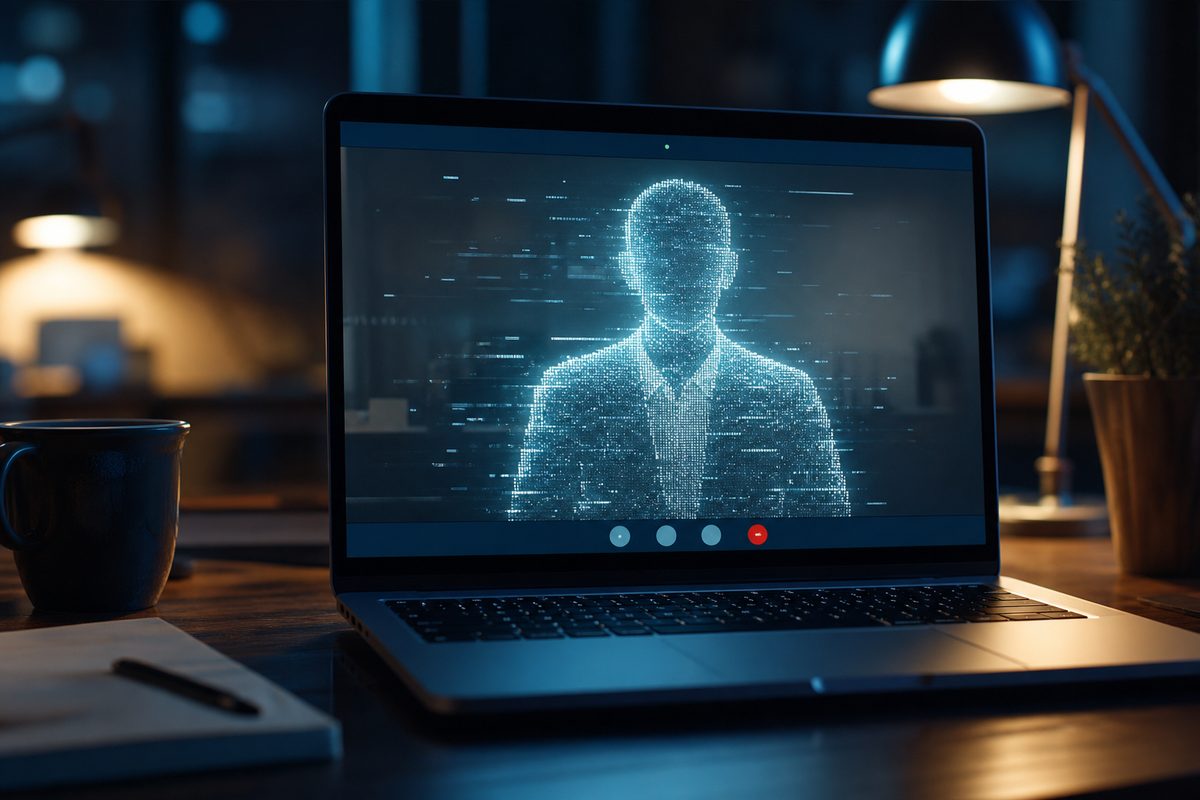
The job candidate who acted a bit too perfect showed up on Anastasios Angelopoulos's calendar like any other applicant. Angelopoulos runs Arena, a company that evaluates AI models, so his engineers know what good AI looks like when they're testing for it. They didn't clock it in the interview.
"They're passing all of our technical interviews," Angelopoulos said on the 20VC podcast in early August. "And then what happens at the end of it? You try to hire them, and it's vaporware." His engineers had interviewed the applicants, believed they were real, and recommended a hire. There was no person on the other end. Just AI, dressed up as a candidate, good enough to get through the whole process.
He doesn't know who's behind it. Corporate espionage, a scraper looking for company data, someone testing how far a fake profile can get. His best guess is "people are trying to get into all of the American businesses." Arena is now weighing whether new hires need to come into the office to collect a laptop, in person, just so someone can shake their hand and confirm they exist.
That last bit made me laugh, then it didn't. Because "verify the human is real" used to be a joke line in a heist film. Now it's a line item on a hiring checklist.
This isn't a one-off
If it were just Arena, I'd file it under "weird AI story, moving on." It's not just Arena.
The FBI put out an alert in 2025 warning that North Korean IT workers had used AI and face-swapping tech in video interviews to hide who they actually were, and landed remote jobs at more than 100 US companies. Once they were in, some used their access to steal proprietary data. Coinbase now makes every new hire fly in for orientation. Amazon runs AI screening specifically to catch suspected North Korean applicants before they get near an interview.
Gartner surveyed 3,000 job candidates in the second quarter of 2025 and found 6% admitted to interview fraud, either pretending to be someone else or getting someone else to pretend to be them. Gartner's own forecast is that one in four candidate profiles worldwide will be fake by 2028. Not fabricated experience on a CV. The entire profile.
And this isn't only nation-state stuff aimed at big tech. Fabric analysed 19,368 AI-run interviews between July 2025 and January 2026 and flagged 38.5% of candidates for cheating behaviour, an on-screen AI feeding them answers in real time. Technical roles cheated at four times the rate of sales roles, 48% versus 12%. And here's the bit that should worry any small business doing volume hiring: using a pass score of 7 out of 10, 61.1% of the candidates flagged as cheating would have sailed straight through anyway. The interview score alone doesn't catch them.
The Hackett Group's 2026 poll of talent acquisition practitioners found 67% had encountered suspected candidate fraud in the past twelve months. Every single one of them said the tell was employment history that didn't hold up under a proper look.
Why this actually matters if you're not hiring engineers at scale
But you're probably not Arena. And you're probably not getting infiltrated by a nation-state. You are, right now though, running interviews the same way most businesses have run them for thirty years: someone talks well on a video call, sounds sharp, answers the questions, and you make a call based on that forty-five minutes.
That forty-five minutes is exactly the surface AI is best at gaming. It's structured, predictable, and it rewards confident answers over verified ones. A candidate with a second screen running an AI model can sound better than someone who actually knows the job, because the AI never stutters, never says "let me think," never gets flustered by a curveball. Fabric called this out directly: false confidence from having answers fed to you is scoring higher than genuine, slightly nervous competence.
So if your hiring process is "have a chat, check the CV, make the call," you're not being careless. You're just running a process built for a world where the person on the call was definitely a person.
I've been through enough hiring rounds for my own team to know how easy it is to fall for the smooth answer. You're tired, you've done six interviews that week, and the seventh person just talks well. Talking well was never actually the job. It just used to be a decent proxy for competence, because faking it convincingly for forty-five minutes straight took real skill. Now it doesn't. Now it takes a second monitor and a subscription.
So that's the actual shift here. Not "AI is scary" but "the thing you used to rely on as a filter no longer filters." A confident, articulate answer used to correlate with someone who knew the material, sort of a proxy you didn't even think about. That correlation is breaking down in real time, and most hiring processes haven't caught up.
What to actually do about it
You don't need enterprise fraud detection software for a five-person team. You need three habits.
Stop trusting the interview score on its own. If someone sails through smoothly with zero hesitation on every question, that's not automatically a green flag. Ask one question with no clean textbook answer, something about a specific decision they made and what it cost them. AI-fed answers are great at general competence and rubbish at specific, messy, personal detail.
Verify employment history before the offer, not after. Hackett's practitioners were unanimous on this: it's where fraud shows up first. A quick call to a listed manager, a look at whether the dates and the story actually line up, catches more than any amount of clever interview questioning, and it takes ten minutes as well.
Make one part of the process impossible to fake remotely. That doesn't have to mean flying people to an office like Arena is considering. It can be as simple as a live screen-share task with follow-up questions on the spot, or a short call where you ask them to walk you through something they built, live, with the camera on their face and hands. Canned answers don't survive live improvisation.
And none of this is about distrusting every applicant. Most people applying for your job are exactly who they say they are. It's about building one checkpoint into the process that a script can't pass, because right now most small business hiring has zero of those and the fraud rate is climbing, not shrinking.
If you want a second pair of eyes on where AI is changing how your business actually runs, not just hiring but the bits nobody's looked at properly, that's what the AI Ops Audit is for. I go through your business, find where a machine is already doing the job badly or a human is doing a job a machine should own, and hand you the order to fix it in. Not a report you file and forget.
Brewed by Steven, poured by Viktor
About Steven Tann: Steven helps business owners build systems that run themselves using AI. After 10+ years helping 7,000+ businesses and building his own autonomous operations, he's the bloke who actually does it, not just talks about it. Find out more at steventann.com.