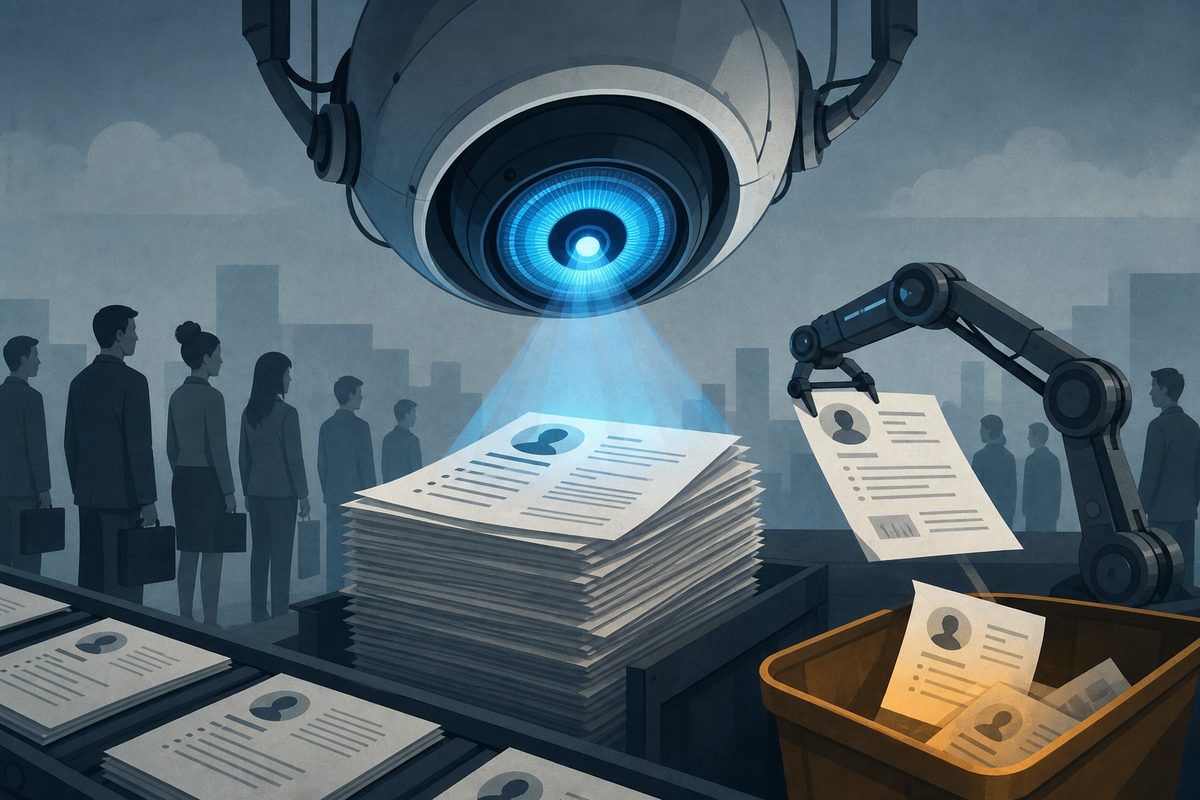
The CV Scanner That Rejected 100 People Before Anyone Asked Why
Derek Mobley applied for jobs. More than one hundred of them.
One hundred applications. Different companies, different roles, different industries. He got back nothing. Not a phone screen. Not a polite "thanks but no thanks" from an actual human. Just silence, repeated a hundred times.
Eventually, he started wondering. Was it him? Were the jobs just that competitive? Or was something else going on?
Turns out, something else was going on. Every single one of those companies used Workday's AI-powered applicant screening platform. And Derek Mobley is over 40.
He sued.
In May 2025, a federal judge in California certified the case as a nationwide collective action. That means anyone in the United States aged 40 or older who got screened out by Workday's AI system since September 2020 could potentially join the lawsuit. Workday says it lacks merit. The courts, so far, disagree.
Here's where it gets interesting for the rest of us.
The Problem Wasn't Evil Intent
Nobody at Workday sat down and thought, "Right, let's build a system that rejects older workers." That's not how this happened.
AI hiring tools learn from data. They look at patterns. Who got hired before? Who performed well? Who got promoted? Feed those patterns into a model, tell it to find more people like that, and off it goes.
The problem is that those historical patterns are full of human bias. If the people who got hired in the past skewed younger, or skewed male, or skewed from certain universities, the AI learns those patterns without anyone realising. It's not being told to discriminate. It's doing what it was designed to do, which is find people who look like the winners. And the winners, historically, weren't always a representative bunch.
Amazon learned this the hard way. The company built an AI recruiting tool and trained it on ten years of CVs. Mostly from men, because that's who'd been applying for technical roles. The system quietly figured out that being male correlated with getting hired. Then it started penalising resumes that included the word "women's." As in "captain of the women's chess club." It downgraded graduates from all-female colleges. Nobody told it to. It just did the maths and drew the wrong conclusions. Amazon scrapped the whole thing.
The Maths on This Is Genuinely Alarming
A Stanford HAI study published in May 2026 found that 90% of U.S. employers now use AI screening tools to sort and rank job seekers, with most relying on the same few third-party vendors. That is not a niche anymore. That is the mainstream.
And a Harvard Business School study found that 88% of those employers admitted their systems reject qualified candidates due to bias or keyword mismatches. So the vast majority of companies using these tools know the tools have a problem, and they're still using them.
And here's the part that should make anyone uncomfortable. Research from the University of Washington, published in November 2025, found that when an AI system had severe bias, humans followed its recommendations around 90% of the time. Not blindly, but close enough to blindly. The AI recommends, the human nods. The human thinks they're making the decision. The algorithm already made it.
So you have a system that might be quietly filtering people by age, or gender, or race, or which university they went to. You have employers who mostly don't know it's happening. And you have humans who, when shown a biased list, tend to pick from that list anyway.
That is not a small problem.
What This Means If You're a Small Business Owner
Look, most small businesses don't have a Workday subscription. You're probably not processing thousands of applications through an enterprise AI system.
But the lesson is broader than one software platform.
If you're using any AI tool to help shortlist candidates, read applications, or score people in any way, you need to understand that the tool is only as fair as the data it was trained on. And you almost certainly don't know what data that was.
Some practical things to think about:
Ask the vendor directly. If you're using any hiring software that uses AI, ask them what they've done about bias. Ask them what their training data looks like. Ask them whether they've had independent audits. If they look at you blankly, that tells you something.
Don't let the algorithm make the final call. AI screening is fine as a first pass to handle volume. But a human should be making the actual decision to interview or reject someone, and that human should be looking at the original application, not just the AI's score.
Watch for "culture fit" as a filter. A lot of AI hiring tools use language around culture fit or values alignment. That language sounds neutral. In practice, it can be code for "looks like the people we already have," which is exactly how bias creeps in.
Keep records. If you're ever challenged on a hiring decision, you need to be able to show your reasoning. If your reasoning is "the software said no," that is not going to be a comfortable place to be sitting in 2026.
Check your job ads as well. AI tools are increasingly used to screen ads for discriminatory language. Some companies are using the same AI to write the ads. You can imagine how that goes.
The Intention Doesn't Matter
This is the bit that trips people up. Business owners often say "we're not trying to discriminate." Nobody is suggesting they are. The Workday situation isn't about bad intentions. It's about a system producing bad outcomes, at scale, repeatedly, without anyone noticing until someone applied 100 times and started counting.
The legal system doesn't ask whether you meant it. Discrimination law, in most countries, works on outcomes. If your process systematically produces a particular outcome for a protected group, the intent behind the process isn't necessarily the defence you think it is.
The other thing worth saying is that this isn't AI going rogue in a dramatic, sci-fi way. There's no villain here. It's just a very mundane form of getting it wrong: feeding a machine data that reflects the past and expecting it to build a fair future.
AI is genuinely useful in hiring. It can handle high volumes. It can catch things humans miss. It can reduce the time it takes to get from "we have a job open" to "we have someone starting."
But it needs watching. It needs auditing. And it needs a human who's actually paying attention, not just rubber-stamping whatever the algorithm suggests.
Derek Mobley applied for jobs at more than a hundred companies and heard nothing back from any of them. Whatever your view on the legal case, that's a story worth sitting with for a moment.
Because if you were the one doing the hiring, and you never saw his application, you'd never know you'd missed him.
---
Sources:
- Mobley v. Workday, Case 3:23-cv-00770-RFL, N.D. California (May 16, 2025)
- Reuters: Amazon scraps secret AI recruiting tool that showed bias against women (Oct 2018)
- Stanford HAI: AI Hiring Tools Can Yield Racial Bias and Systemic Rejection (May 2026)
- Harvard Business School: Hidden Workers, Untapped Talent (2021)
- University of Washington: People mirror AI systems' hiring biases (Nov 2025)
---
If you want to talk this through with people who are actually doing it, come join us in The Autonomous Business on Facebook. No gurus, no fluff, just real conversations with business owners building systems that run themselves.
---
About Steven Tann: Steven helps business owners build systems that run themselves using AI. After 10+ years helping 7,000+ businesses and building his own autonomous operations, he's the bloke who actually does it, not just talks about it. Find out more at steventann.com.