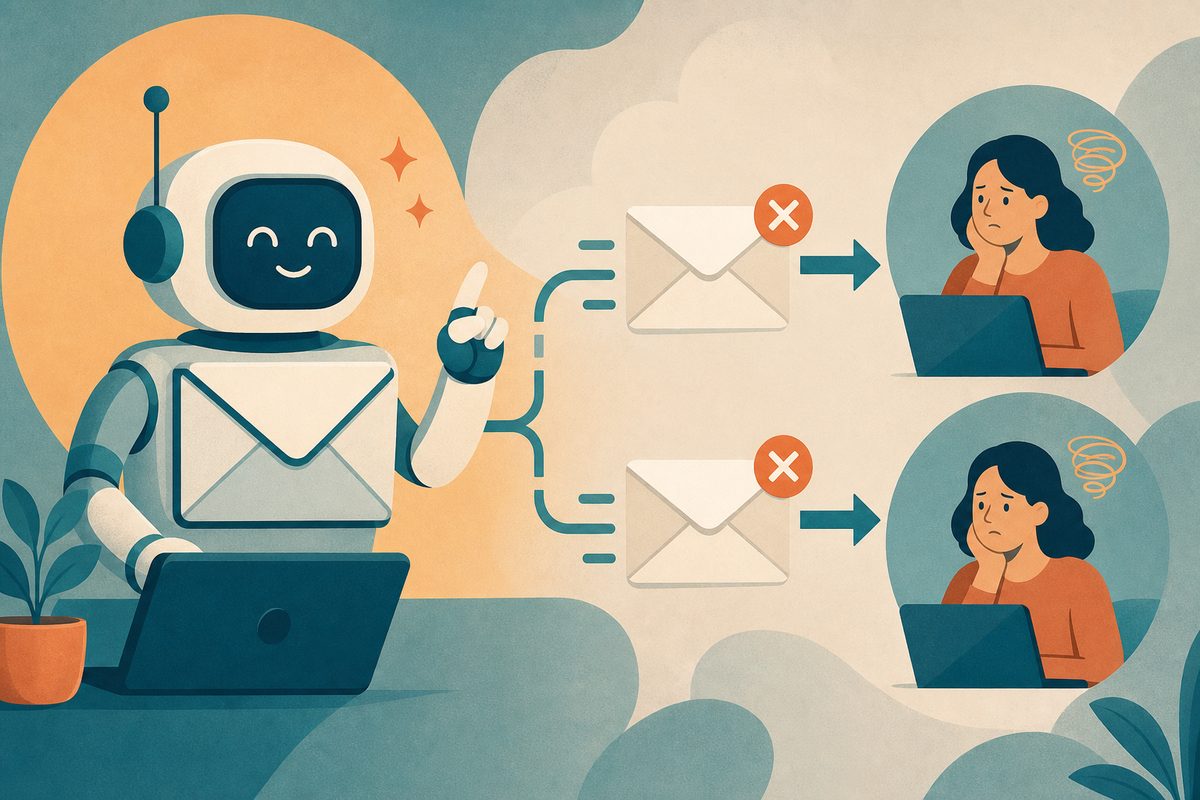
A woman buys toilet paper. Same brand, same subscription, same 48 rolls every few weeks, for years. Then an email lands telling her the deal's changing. Instead of 48 rolls for $66, she's now getting 24 rolls for $69.50.
Read those numbers again slowly. Half the rolls. More money. Her price per roll just went from $1.38 to $2.90. That's not a price rise, mate, that's a price rise wearing a price rise's coat and holding a knife.
This actually happened in July this year to a customer of Who Gives A Crap, the Australian toilet paper company that gives most of its profits to building toilets in developing countries. Good business, good mission, proper humans running it. And an AI email agent that nearly started a riot in the customer's inbox.
The bit that actually matters
Here's where it gets interesting, because a wrong number in one email is a typo. It happens. Someone fat-fingers a spreadsheet, nobody proofreads it, off it goes. Embarrassing, but human.
What happened next is the actual story. The customer wrote back, confused, asking if that price was really correct. And the company's support flow sent a second AI-drafted email confirming the mistake. Not correcting it. Confirming it. The reply said the subscription would "indeed" be changing to 24 rolls at $69.50, apologised for "unclear messaging," and sent the customer on their way still believing their toilet paper had just gone up 110% overnight.
Two separate AI-generated emails, both wrong, both confident. A spokesperson later told SmartCompany the original email had a typo, the $69.50 was actually meant to cover 48 rolls, not 24, and the company had "identified the root cause" and shut the whole email agent down.
That's the pub-chat version. Here's the bit that should worry you if you're running one of these tools in your own business: the second email is the actual failure mode of AI customer service, not the first. A single wrong output is a bug. An AI system that then defends its own wrong output when a customer politely pushes back, using the exact confident tone it uses when it's right, is a design problem.
Most AI email and chat tools don't know the difference between "I am certain" and "I am guessing based on a pattern that looked similar." They say both in the same voice. A human support agent who wasn't sure would usually say "let me check that for you." An AI agent that wasn't sure just picked the most plausible-sounding sentence and sent it, twice.
Why this isn't a "don't use AI for support" post
I run an AI ops business. I'm not about to tell you to switch the whole lot off and go back to hold music. Half my own operation runs on AI doing exactly this kind of drafting, and it works, because there's a human checkpoint in the places it actually matters.
The lesson from Who Gives A Crap isn't "AI bad." It's "no verification loop on the one email type where a mistake compounds itself." Price change emails are exactly the wrong place to let an agent run fully hands-off, because:
- The stakes are asymmetric. Get a "your order has shipped" email wrong and nobody cares. Get a price email wrong and every customer who reads it starts doing maths against you, in public, on review sites.
- Confused customers ask follow-up questions, and if the same AI agent handles the follow-up with no fresh check against the source data, you get exactly what happened here: the error gets reconfirmed by the system that made it, with an apology bolted on for tone.
- There was no second reader. Somewhere between "draft the price change email" and "send it," a human should have glanced at the actual dollar figures against the actual new price list. That's a thirty-second check. It didn't happen, or the tool that generated the numbers pulled from the wrong source and nobody checked that either.
What to actually do about it
If you're running any AI tool that touches money, quantities, or dates in customer-facing messages, here's the fix, and it costs you nothing but a bit of discipline:
Rule one: numbers get a second source. Before an AI-drafted email with a price, quantity, or date goes out, that number gets checked against the system of record, not against what the AI "remembers" from the last email in the thread. A simple rule in your workflow: any message containing a dollar figure or a quantity change routes to a human for a ten-second glance before sending. Not a review of the tone or the wording, just the numbers.
Rule two: escalate confusion, don't automate it. If a customer replies asking "is this right?", that's a signal the first message might have failed. Route that specific pattern, questions about a previous automated message, straight to a human. Don't let the same tool that made the mistake mark its own homework.
Rule three: test the failure case, not just the happy path. Most businesses test their AI tools by checking a handful of normal customer emails go out fine. Nobody tests what happens when the tool has to explain a mistake it just made. That's the scenario that actually happened here, and it's the one nobody thinks to check before launch.
None of this is complicated. It's the same discipline you'd want from a junior staff member handling pricing emails: check the number before it leaves the building, and if a customer pushes back, get someone senior to look before replying again. AI doesn't change that rule. It just makes it easier to skip, because the draft looks so tidy you assume it's right.
I'd bet money most businesses running an AI email agent right now have never actually asked it a hard question about its own mistake and watched what comes back. Try it this week. Send your support inbox a message pretending to be a confused customer questioning a number the AI drafted. See if it checks the source data again, or just repeats itself more politely. That one test will tell you more about your setup than any vendor demo did.
The other thing worth noticing here is what didn't go wrong. Nobody at Who Gives A Crap tried to blame the customer for misreading the email, and nobody tried to argue the maths wasn't really that bad. A company built around an unglamorous product still managed the correction with a straight face and a fast fix, which is more than plenty of much bigger brands manage when their own AI tools embarrass them in public.
Who Gives A Crap did the right thing once they caught it: shut the agent down, found the root cause, sent a correction. That's a company that treats an AI mistake the way you'd treat a human one, own it fast, fix it properly, don't let pride slow down the correction. Worth copying that part too.
Sources
- Who Gives A Crap suspends AI agent after email error said prices would double, SmartCompany, 8 July 2026.
Want to see how this could work in your business? Book a call and let's talk about where you're at and what's possible.
Brewed by Steven, poured by Viktor
About Steven Tann: Steven helps business owners build systems that run themselves using AI. After 10+ years helping 7,000+ businesses and building his own autonomous operations, he's the bloke who actually does it, not just talks about it. Find out more at steventann.com.