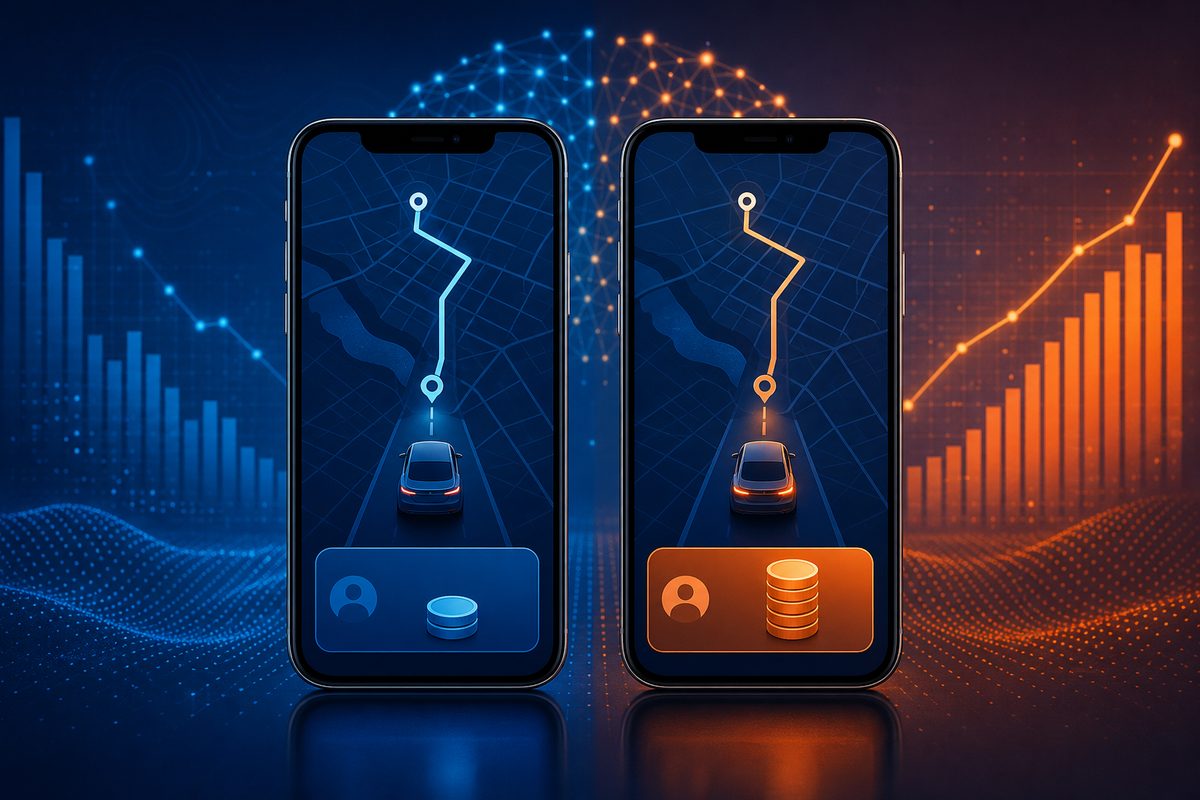
My mate Dave got into an Uber outside a pub in Manchester last Friday night. Twelve quid. His wife, standing two feet away, same destination, same time: seventeen quid. She assumed it was the app playing up. She was right. Just not in the way she thought.
This isn't a one-off. This is the business model.
The Same Ride. Different Price. Every Time.
Consumer Reports ran a months-long investigation into Uber and Lyft, published in June 2026. They tested 30 routes across 17 US states. They found that for the same trip, at the same time, from the same starting point to the same destination, the median price difference between the lowest and highest fare was 42.4 percent.
Not 42.4 percent during a surge. Not 42.4 percent because someone booked in advance. 42.4 percent because the algorithm decided, in the same minute, that one phone was worth more than another.
And they also found that 12.4 percent of all discounts shown on both platforms appeared to be fake. Not real promotions. Inflated list prices with a discount applied on top to make the deal look better than it was. Consumer Reports called them "fictitious discounts." Experts say they may violate consumer protection laws in several US states.
Uber and Lyft denied it. They said it was just "real-time marketplace conditions."
Right.
It's Not Just Rides
If you thought that was isolated to a couple of ride-hailing apps, it gets more interesting.
In June 2026, a group of California drivers filed a federal class action lawsuit against BP, 7-Eleven, Walmart, Albertsons, and a dozen other gas station operators. The claim: they were all using an AI pricing tool made by a company called Kalibrate to share non-public pricing data with each other and coordinate price hikes.
According to the lawsuit, gas prices in affected areas surged by as much as 30 cents per gallon, with some California pumps hitting seven dollars a litre. The complaint alleges that a single one-cent-per-gallon increase costs California drivers an additional $134 million annually. California already pays the highest fuel prices in the country.
The defendants named include companies running over 1,700 stations across California. They all deny wrongdoing. And Kalibrate says its software helps stations stay "locally competitive."
But here's the thing. You do not need explicit collusion if every station uses the same algorithm trained on the same data. And the coordination happens automatically.
The Rent Version Did This for Years
This isn't new territory. The rental housing market got there first.
A company called RealPage had been running a similar setup for landlords across the US for years. Landlords using the software would share occupancy data with RealPage. The algorithm would use that data, including non-public information from competing properties, to set recommended rents. Landlords followed the recommendations. Rents went up.
In August 2024, the US Department of Justice sued RealPage for algorithmic price-fixing that harmed millions of American renters. In November 2025, they reached a proposed settlement requiring RealPage to stop using competitors' non-public data in real-time pricing recommendations.
No fines. No admission of wrongdoing. Just: stop doing the specific thing you were doing.
The issue wasn't that the algorithm was buggy. It worked exactly as designed.
Why This Happens
Here's what's going on under the hood, without getting too nerdy about it.
When you feed an AI pricing system data from multiple competitors, it learns the patterns. It sort of learns when prices cluster, when they diverge, and how to maximise revenue across the whole market rather than for a single business. If enough businesses in the same market use the same system, the effect is what economists call "algorithmic coordination."
Nobody picks up the phone and says "let's all charge more." Nobody needs to. The software does it through shared data and shared recommendations. And because each business is just "following its AI's suggestion," no one person made the decision. That's also, conveniently, a very tidy legal defence.
The Uber/Lyft version adds another layer: personalised pricing. The algorithm does not just react to supply and demand. It also looks at what it knows about you. Your device, your location, your history, maybe whether you look like someone who will pay more to avoid waiting. It charges accordingly.
You don't know it's happening. You have no way to find out. You just pay.
What Small Businesses Need to Understand
Most of the businesses reading this are not running ride-hailing empires. But this matters to you for a few reasons.
First, you are probably on the receiving end of this. Every time a supplier, platform, or marketplace uses AI pricing, there is a chance you are being charged more than someone else for the same thing. It happens with ad platforms, cloud computing, and procurement software. Worth knowing, as well.
Second, if you use any pricing or revenue management tool, check what data it is sharing. If your software is pulling in competitor data, ask how. If it is recommending prices based on market-wide inputs, ask where those inputs come from. The law around algorithmic pricing is shifting fast, and the courts are no longer treating "the algorithm told us to" as a complete answer.
Third, if you are building pricing automation yourself, be very clear about what you are optimising for. There is a difference between pricing to reflect your actual costs and value, and pricing to extract the maximum from each customer based on what your system thinks they will pay. The second one is becoming legally and reputationally risky at pace.
The Instacart One
While I am here: Consumer Reports and Groundwork Collaborative also investigated Instacart in late 2025. They found that some customers were being charged up to 23 percent more than others for the same groceries at the same time. Albertsons, Costco, Kroger, Safeway, Sprouts, and Target were all named.
The kicker: Instacart had disclosed it was running pricing experiments in its investor materials. They called the price differences "small and negligible." Consumer Reports found they were not. Instacart stopped the practice after the investigation went public.
So at least someone blinked.
The Bigger Point
AI did not create price discrimination. Businesses have always charged what the market will bear. A hotel charges more on a Friday night. A florist charges more on Valentine's Day. That is not new and it is not wrong.
What AI has changed is the scale, the opacity, and the granularity. Not surge pricing for a Friday night in the rain. Surge pricing for you, specifically, right now, on that route, because the algorithm decided your phone looks like a person who will pay 42 percent more.
You don't see the ceiling price. You do not know what the person next to you paid. You've got no reference point. That's not dynamic pricing. That's asymmetric information with an algorithm holding all the cards.
The courts are starting to notice. Regulators are starting to catch up. And every company that spent the last three years building this into their product is going to have a lot of explaining to do.
In the meantime: next time you get a "discount" on an Uber, have a look at whether it looks like it was discounted from a number that seems oddly high.
It's probably not a coincidence.
---
Sources
- Consumer Reports: Different Prices for the Same Ride: How Uber and Lyft Use AI to Get More Money Out of You (June 2026)
- NY Post: Uber, Lyft sell identical rides at vastly different prices, offer fake discounts using AI-driven pricing (June 2026)
- The Guardian: California drivers sue gas stations for allegedly using AI to inflate prices (June 2026)
- ABC News: AI is helping gas stations collude to raise California fuel prices, lawsuit says (June 2026)
- Car and Driver: Class-Action Lawsuit Blames AI for Gas Price Inflation in California (June 2026)
- DOJ: Justice Department Sues RealPage for Algorithmic Pricing Scheme that Harms Millions of American Renters (August 2024)
- NPR: New limits for rent algorithm that prosecutors say lets landlords drive up prices (November 2025)
- Consumer Reports: Instacart's AI Pricing May Be Inflating Your Grocery Bill (December 2025)
---
Want to see how this could work in your business? Book a call and let's talk about where you're at and what's possible.
---
About Steven Tann: Steven helps business owners build systems that run themselves using AI. After 10+ years helping 7,000+ businesses and building his own autonomous operations, he's the bloke who actually does it, not just talks about it. Find out more at steventann.com.