The Chatbot That Wouldn't Put a Human on the Phone. Over a Chewed-Up Cable.
A bloke's dog chewed through his AT&T internet line. Not a complicated problem. A technician swaps a cable, job done, everyone gets on with their day.
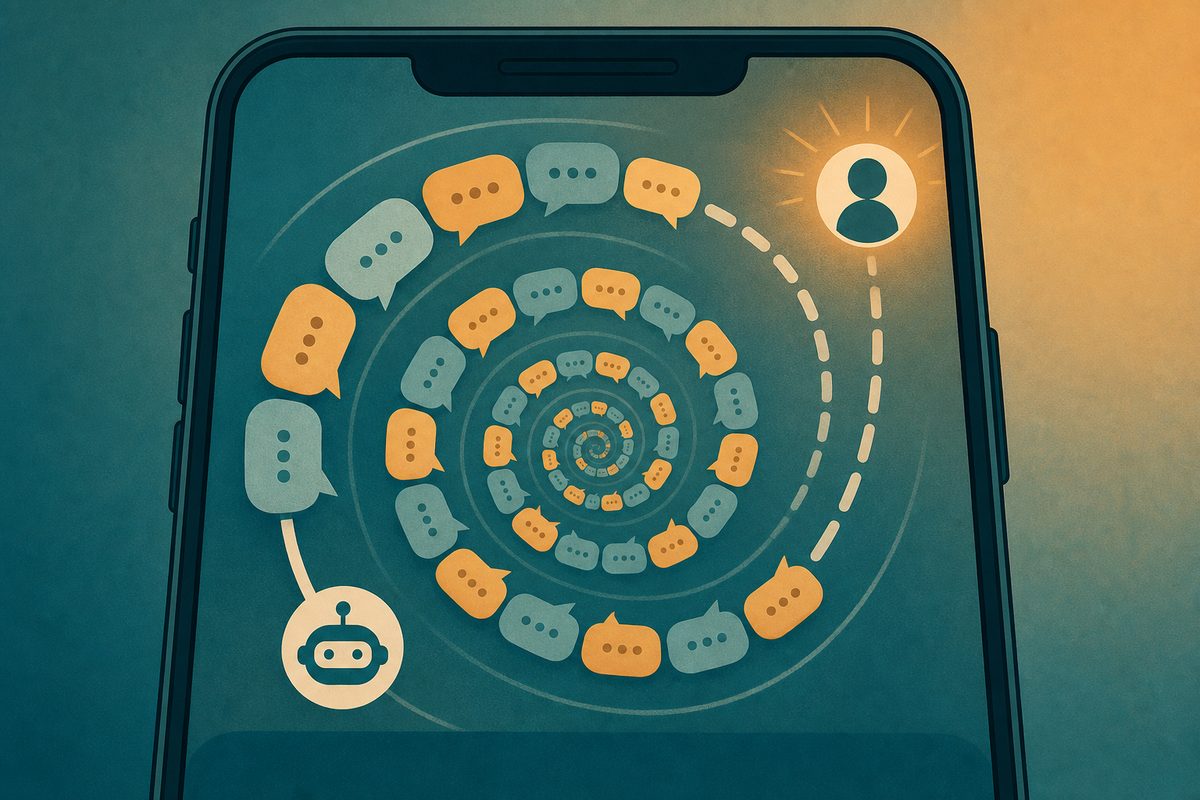
Instead, the customer spent a chunk of his evening arguing with AT&T's chatbot, Andi, trying to get it to log the fault and hand him over to an actual person. Andi wouldn't do it. According to the screenshots the Redditor posted (username "SnooPeripherals2206"), the bot kept circling back to the same non-answers, asking for details it already had, and never once producing a human being. Wccftech covered the whole exchange and called it, fairly, a "death loop." Verizon's chatbot got a mention in the same piece for producing similarly hollow, ChatGPT-flavoured replies that don't actually resolve anything.
Here's the bit that should worry every business owner reading this, not just AT&T customers. This isn't really a story about a chatbot giving a wrong answer. It had no idea how to admit it couldn't help. And no path to hand the problem to someone who could. That's a different failure mode to the one everyone's been talking about for two years.
Everyone's watching for hallucinations. That's not where the failures are.
Since ChatGPT showed up, the fear has been "what if the AI makes something up." Fake court cases, invented refund policies, that sort of thing. Fair concern. But a new report from ChatSee.ai, which analysed more than 10,000 enterprise AI failure events, found hallucinations account for less than 10% of the failures they catalogued. The single biggest category, at 31.1% of all observed failures, was what they call "resolution and escalation breakdowns." That's the AI equivalent of Andi: the system keeps talking, keeps sounding helpful, and never actually closes the loop or gets the human involved when it should.
So the same ChatSee report found execution and action failures (the AI attempting to do something and getting it wrong or half-done) are up 62% against their 2024 baseline. As more businesses hand real tasks to AI instead of just chat, the ways it can go wrong multiply. Getting an answer wrong is embarrassing. But never admitting you're stuck, and never letting the customer escape to a human, is what actually costs you the relationship.
And customers already don't trust the category much to begin with. A Gartner survey of 5,728 customers found 64% would prefer companies didn't use AI in customer service at all, and 53% said they'd consider switching to a competitor over it. Separately, Acquire BPO's AI in Customer Service Survey found 70% of consumers would look at a different brand after just one bad AI support experience. You don't get ten chances to get this right. You get about one.
Worth saying too: this isn't an AT&T-specific problem, and it's not really about telecoms. Swap the internet cable for a late delivery, a double-booked appointment, or a refund the customer swears was promised on a call last month, and you've got the exact same shape of failure. The bot handles the clean version of the enquiry fine. The messy, human version, the one where the customer is already a bit annoyed and just wants someone to say "right, I'll sort it," is where it falls over. And that's precisely the version of the enquiry that decides whether you keep the customer or lose them.
Why this happens (and it's not because the AI is dumb)
Andi isn't a badly built product because AT&T is incompetent. Somewhere in the design, "always keep the conversation going" won out over "know when you're beaten and get out of the way." Most AI customer service tools get built and tested on the easy stuff: password resets, order status, store hours. Nobody stress-tests the awkward, messy end, the billing dispute, the "my dog ate the cable," the genuinely annoyed customer. That's exactly where a bot with no honest exit ramp turns a five-minute fix into an evening wasted arguing with software.
I've said this before and I'll keep saying it: the AI isn't the problem. The lack of a proper escape hatch is the problem. If you're running any AI in front of your customers, whether that's a GoHighLevel bot, a voice agent, or a chat widget bolted onto your website, the question isn't "can it handle every enquiry that comes in." It's "does it know exactly when to stop pretending and put a real person in front of the customer, and does that handover actually work."
Three things to check on your own setup
1. Test the exit, not just the entry. Everyone tests whether their bot can answer the easy question. Almost nobody deliberately winds the bot up, throws it a weird edge case, and checks what happens next. Do that. Type something genuinely annoying into your own chatbot this week and see whether it gets you to a human inside two exchanges. If it doesn't, that's a live problem, not a hypothetical one.
2. Set a hard trigger, not a vibe. "Escalate when the customer seems frustrated" is not a rule an AI can reliably follow. "Escalate after two failed attempts to resolve the same request" is. Build the trigger around a countable thing, not a feeling.
3. Make the handover actually carry the context. Half the fury in the AT&T thread wasn't just the loop, it was the fear that even if a human turned up, the customer would have to explain the whole chewed-cable saga again from scratch. If your escalation dumps the customer back to zero with a fresh agent, you've solved half the problem and left the other half exactly as annoying.
None of this means don't use AI in customer service. I run plenty of it myself, and it saves proper hours every week when it's pointed at the right jobs. It means build the exit before you build the front door, and go looking for the failure yourself before a customer, or a Reddit thread, finds it for you.
There's also a quieter cost to this that doesn't show up in a Reddit thread. Every one of those failed loops still takes up a support seat, still generates a ticket, still eats staff time when the customer finally does reach a person, now twice as annoyed as when they started. A bot that can't escalate properly doesn't save you money. It just moves the cost further down the line and adds interest to it. If you're measuring your AI setup purely on how many enquiries it "deflects" from a human, you're measuring the wrong thing. Deflection with no resolution is just a delay with extra steps.
If you're an agency or a GHL admin building this for clients, this is worth putting in writing before you switch a bot live: an agreed, tested rule for when it hands off, and proof that the handover carries context with it. That one clause in the build brief will save you the awkward call three weeks later.
Sources:
- AT&T Cozing Up To AI Has Made Its Customer Service Outrageously Poor, Wccftech, 23 July 2026
- New Research Finds Enterprise AI Failures Are Shifting Beyond Hallucinations, ChatSee.ai via Yahoo Finance/PR Newswire, 29 July 2026
- 64% of customers not keen on AI-powered customer service, The Register, 9 July 2024 (Gartner survey of 5,728 customers, Dec 2023)
- One Bad AI Experience Could Drive Customers Away, Acquire BPO Study Warns, 2024
If you want to talk this through with people who are actually doing it, come join us in The Autonomous Business on Facebook. No gurus, no fluff, just real conversations with business owners building systems that run themselves.
Brewed by Steven, poured by Viktor
About Steven Tann: Steven helps business owners build systems that run themselves using AI. After 10+ years helping 7,000+ businesses and building his own autonomous operations, he's the bloke who actually does it, not just talks about it. Find out more at steventann.com.