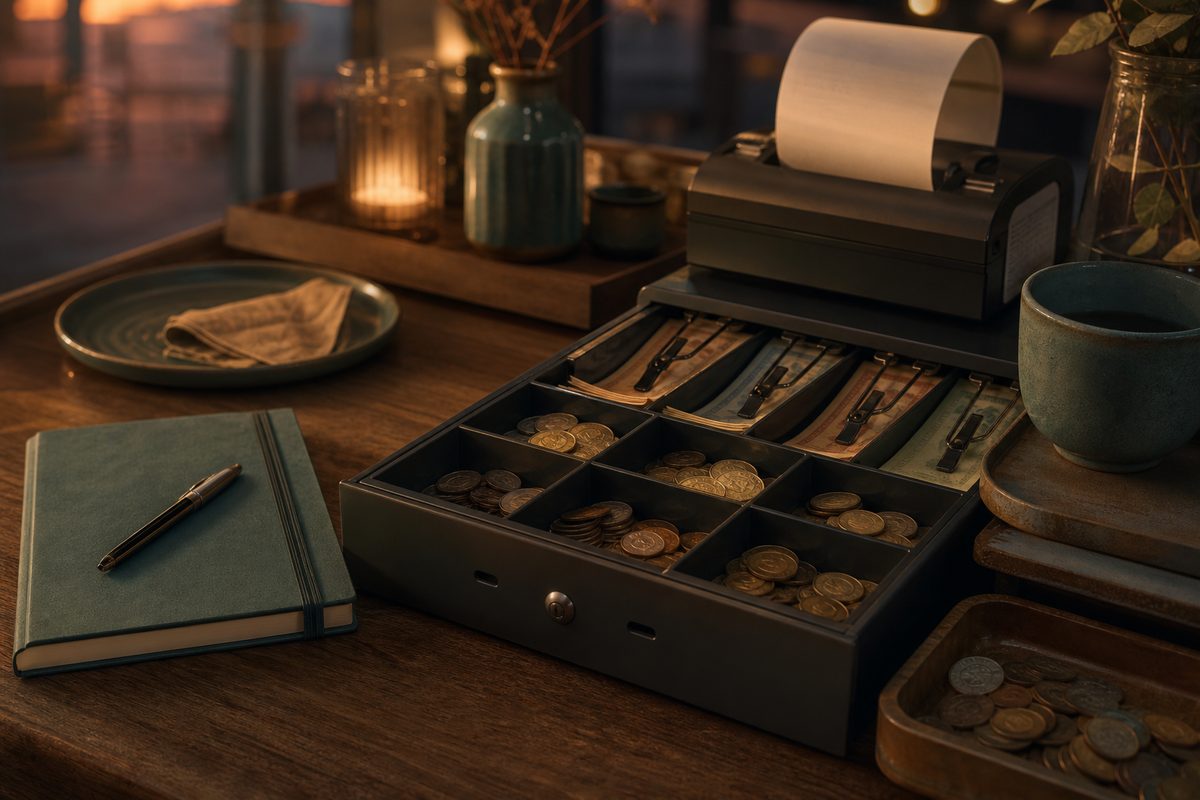
The till was two pounds forty short again.
Not the first time. Not the tenth time either. Sharon runs a cafe in Stockport, six tables and a decent lunch trade, and every night at close she counts the drawer against the till roll and every few nights it doesn't match. Two quid here. A fiver there. Once it was thirty quid short and she spent forty minutes going back through the day's receipts trying to work out where it went, only to find someone had given change for a twenty when it was actually a ten.
Here's the thing. Sharon isn't bad at running a business. She's good at it, as well as being flat out busy most days. But cash reconciliation is the job nobody signed up for and everybody has to do, and by the time you're doing it at 9pm after a full shift, you're tired, the numbers blur, and small mistakes get written off as "close enough" instead of found and fixed.
Do the maths on that. The British Retail Consortium found UK retailers lose an average of £11 a day per store to cash handling errors, most of it down to miscounts rather than theft. Eleven quid doesn't sound like much until you multiply it by 365. That's just over four grand a year, disappearing in dribs and drabs, never once showing up as a single alarming number so nobody ever chases it down.
And it's not really about the money. It's about the time. Every discrepancy means someone has to stop, go back through the day, and hunt for where two numbers stopped agreeing. HMRC's own retail scheme guidance has an entire section on "unders and overs" because it happens constantly enough that the tax office needed a formal name for it.
Why the manual version keeps failing
So most small businesses handle this one of two ways. Either someone manually counts the till against the till roll at close and writes the number in a book, or they don't bother reconciling daily at all and just hope the monthly bank statement roughly lines up. Neither one catches the problem when it's cheap to catch.
The businesses that actually get on top of this do the same thing every day: reconcile cash at the same time each day, compare the totals consistently, and investigate discrepancies immediately rather than carrying them forward. That's proper advice. It's also advice nobody follows for more than a fortnight, because it's manual, it's boring, and it's the first thing that gets skipped on a busy night.
But this is a job for a machine, not a habit. You don't need willpower to check a number every day. You need a system that checks it for you and only bothers you when something's actually wrong.
What the fix looks like
You don't need a new till system or a five-figure POS overhaul. Most modern point-of-sale systems (Square, Lightspeed, even a lot of the GHL-connected setups I build for clients) already produce an end-of-day Z-report with total sales, card totals, and expected cash. The fix is wiring that report into an automated check instead of a human eyeballing it at the end of a long shift.
Here's the version I'd build for a business like Sharon's:
- Pull the Z-report automatically the moment the till closes for the day, rather than waiting for someone to remember to run it.
- Cross-check it against the card processor's settlement total. If the till says £1,240 in card sales and the processor says £1,190 came through, that's a forty-minute investigation waiting to happen tomorrow instead of tonight, and it's much harder to trace after a night's sleep.
- Flag only the discrepancies above a threshold (say, £5) straight to a Slack channel or a text message, with the till number, the card total, and the gap. No discrepancy, no message. Nobody needs a "reconciliation complete, all good" ping every single night, that's just more noise.
- Log every flagged discrepancy in a running sheet automatically, with date, amount, and a note field someone fills in once they've worked out why. Over a month you start seeing patterns: is it always the same shift, the same till, the same staff member? That's the actual value here, not catching one £2.40 gap, it's catching the pattern behind fifteen of them.
And none of this needs AI in any clever sense. It's a scheduled automation pulling two numbers from two systems and comparing them. The "intelligence" bit is deciding what threshold matters and what to do when it's crossed, and that's sort of a fifteen-minute conversation, not a development project.
What it actually buys you
For Sharon, the honest answer is: about twenty minutes a day back, and the end of the mystery-shortage anxiety that creeps in every time the drawer doesn't balance. Twenty minutes a day is over two hours a week. Over a year, that's more than a hundred hours she's not spending hunched over a till roll wondering if she miscounted or someone else did.
The bigger win is catching the pattern early. A one-off £2.40 gap is nothing. Fifteen small gaps from the same till over six weeks is either a training issue, a broken card reader, or something worse, and you want to know which one within days, not find out at year-end when your accountant asks why the cash position doesn't match the books.
So if you're running any kind of business that touches physical cash, whether that's a cafe, a salon, a market stall or a trades business that still takes cash on the day, this is a Monday afternoon build, not a Q3 project. Pull the numbers, set the threshold, wire up the alert. Then go back to running the business instead of auditing it every night.
If you want to talk this through with people who are actually doing it, come join us in The Autonomous Business on Facebook. No gurus, just real conversations with business owners building systems that run themselves.
Brewed by Steven, poured by Viktor
About Steven Tann: Steven helps business owners build systems that run themselves using AI. After 10+ years helping 7,000+ businesses and building his own autonomous operations, he's the bloke who actually does it, not just talks about it. Find out more at steventann.com.