The Four Pillars of an Autonomous Business (And Why Most People Only Build One of Them)
Every week, I talk to business owners who've automated something. A follow-up email. A social media post. Maybe an invoice reminder. And they're pleased with themselves. Fair enough. It's a start.
Then they ask me why it still feels like the business can't run without them.
The answer, almost every time, is the same. They've built one pillar and called it an autonomous business. It's like laying a single foundation wall and wondering why the house won't stand up.
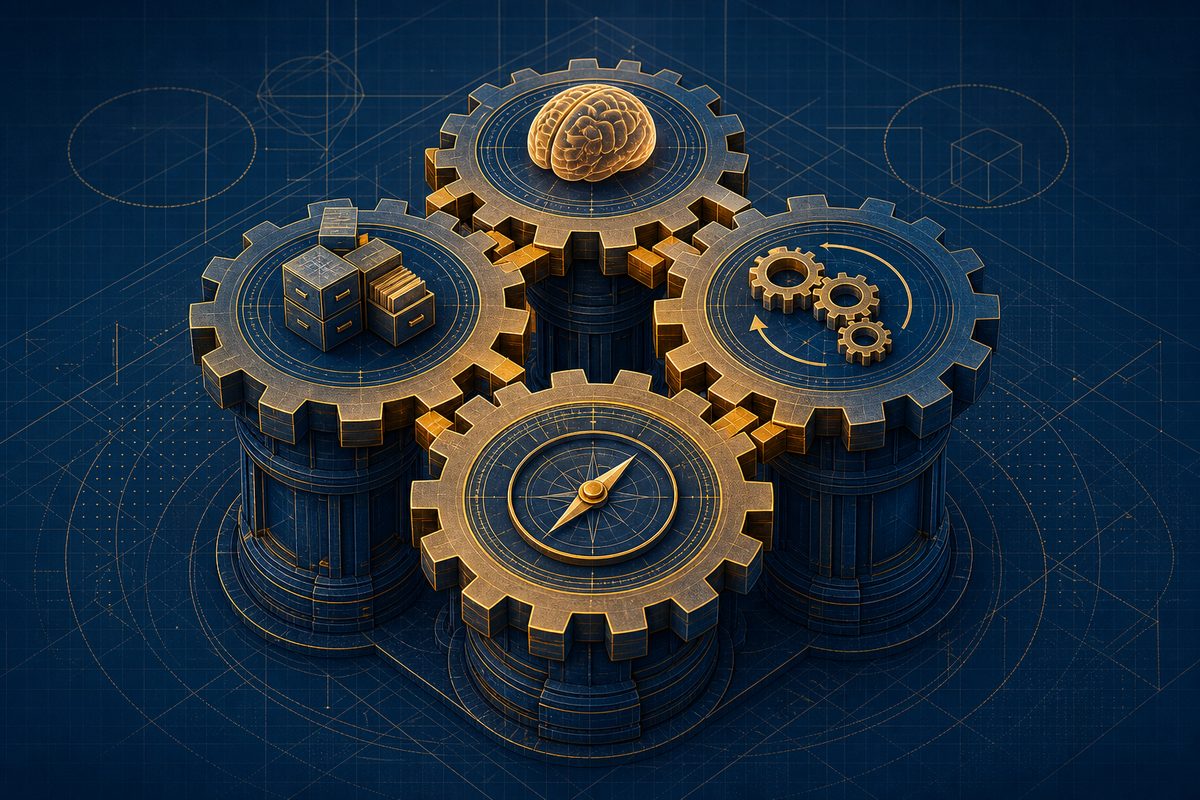
There are four pillars to an autonomous business. Not one. Not three. Four. Miss any of them, and the whole thing wobbles. I know because I've built this thing myself, from scratch, on a narrowboat on the English waterways, managing over 7,000 businesses remotely. I've also watched hundreds of other business owners try to get there, and I've seen exactly where they fall over.
Here's the framework I use.
---
Pillar 1: Memory
Your business has more knowledge than you realise. It's just locked in your head, in email threads, in Slack conversations that scroll off the screen, in documents nobody can find.
According to HBR, employees waste an average of 10% of their workweek searching for information they need to do their job. For a five-person team, that's half a person's week. Gone. Every week. Just hunting for stuff that should be findable in seconds.
An autonomous business treats knowledge as an asset it actively maintains. That means:
- A living knowledge base that your AI can read and act on
- Documented processes, voice profiles, standard operating procedures, business context
- A system for capturing decisions and learnings so they don't vanish when a project ends
This is the pillar most people skip because it feels like admin. It is admin. But it's the admin that makes everything else work. And without it, your AI is a very capable person who knows absolutely nothing about your business.
My own setup has a detailed knowledge base my AI coworker reads before every task. It knows my voice, my business context, which channels to post to, what's banned, what's preferred. It knows things about my business that I would otherwise have to re-explain every single day.
So that's Memory. Your AI is only as useful as what it knows. Feed it well.
---
Pillar 2: Automation
This is the one everyone starts with. Automating tasks, workflows, triggers. It's also the one that goes wrong most often because people automate the wrong things.
The businesses seeing the strongest ROI from automation share one pattern: they start with a single high-volume process, prove it works, then expand. They don't try to automate everything at once.
When Forrester studied workflow automation across real businesses, they found an average ROI of 260% over three years. Payback in under six months. That's not magic. That's just picking the right processes and doing them properly.
The right processes to automate are:
- High frequency. Something that happens daily or weekly, not once a quarter.
- Rule-based. If X happens, do Y. Not "it depends".
- Currently done manually. Not something that's already broken.
Automating a broken process just makes the broken thing happen faster.
In my business, I've automated: daily blog creation and publication, social media posts, email newsletters to 1,500 subscribers, lead follow-up sequences, client reporting, morning briefings, meeting summaries, and more. Each of those was built one at a time. Tested, refined, then left to run.
Automation without Memory is brittle. The automations that fail are almost always the ones that don't know enough context to make good decisions.
---
Pillar 3: Integration
Here's where the clever bit happens.
You can have great Memory. You can have solid Automation. But if your systems don't talk to each other, you end up doing manual work to bridge the gaps. Exporting from this tool, importing to that one. Copying data between tabs. Checking three different places to see what's happening in your business.
Integration is what turns a collection of automated tasks into an actual system.
Most small businesses use more than 5 different tools with fragmented knowledge between them. The information that lives in your CRM doesn't flow to your accounting software. The lead that came in on your website doesn't automatically update your sales pipeline. The meeting notes from last Thursday don't get into the project brief.
Every one of those gaps is a manual job waiting to happen.
Integration means:
- Your tools pass data to each other without human intervention
- Triggers in one system cause actions in another
- You have a single source of truth instead of five slightly different versions of the same thing
I use a central platform (GHL) as the connective tissue for most of my client-facing operations. Everything else integrates into it or feeds from it. When a new enquiry comes in, it flows into the CRM, triggers a follow-up sequence, notifies the right person, and logs the source. Nobody has to do any of that manually.
Without Integration, Automation is just a bunch of islands.
---
Pillar 4: Direction
This is the one people forget until something goes wrong.
Direction is the human judgement layer. The strategic oversight. The bit where someone is actually looking at what the system is doing and deciding if it's still pointed the right way.
The average SMB employee saves 5.6 hours per week from AI tools. The smart business owners use that reclaimed time to think clearly about where the business is headed, not to fill the gap with more busywork.
Direction looks like:
- A weekly review of what your automated systems produced
- Decisions about which new processes to automate next
- Checking that the outputs your AI creates actually match your goals
- Knowing when to step in and override the system
This isn't a lot of work. My version of Direction is about an hour on Monday mornings. I look at the previous week's outputs, flag anything that needs adjusting, update the Memory where something's changed, and make a handful of decisions that the system then executes for the rest of the week.
An autonomous business doesn't mean a business that runs with zero human input. It means a business where human input is reserved for the things only humans should be doing: strategy, relationships, creative judgement. Not copy-pasting data between spreadsheets at 11pm.
Direction without the other three pillars is just wishful thinking. With them, it's the multiplier that makes everything compound.
---
Why Most Businesses Stall After the First Pillar
Here's the pattern I see repeatedly.
Someone discovers automation. They set up a few workflows. Things feel better for a few weeks. And then the improvement just stops. The automations are running on stale information (no Memory), they're not connected to the rest of the business (no Integration), and nobody is checking whether they're still working properly (no Direction).
The business is still dependent on the owner. The automations exist but the owner is the glue that holds them together.
That's the trap.
An autonomous business isn't a collection of automations. It's a coherent system where Memory, Automation, Integration, and Direction work together. Pull any one out and you're back to being the glue.
---
Where to Start
You don't build all four at once. That's how you build nothing.
Start with Memory. Document one process completely. Your most common client onboarding. Your weekly reporting. Your standard proposal structure. Get it out of your head and into a format your AI can actually use.
Then automate that process.
Then connect the automation to your other tools.
Then set up a weekly review so you know it's working.
That's one autonomous loop. Then you build the next one.
This is exactly what The Autonomous Business framework covers, and it's what I help business owners set up when they're ready to stop being the engine and start being the driver. If you're running Build Night sessions or exploring the AI Setup Kit, you're already building Memory. The other pillars come next.
The businesses that get this right don't feel overwhelmed by AI. They feel like they finally got a system that keeps working without them having to babysit it. Sort of like having a very good team member who also never forgets anything and works Sundays.
That's the whole point.
---
Sources
- HBR / Bloomfire (April 2025): "How Knowledge Mismanagement is Costing Your Company Millions": employees waste 10% of workweek searching for information. https://hbr.org/sponsored/2025/04/how-knowledge-mismanagement-is-costing-your-company-millions
- Credare Research (April 2026): "Australian SME AI Adoption Report 2026": businesses seeing strongest ROI start with single pilot, prove ROI within 90 days. https://credare.ai/research/
- Forrester / Pipefy TEI Study (December 2024): 260% ROI over three years, payback under 6 months. https://tei.forrester.com/go/Pipefy/PipefyTEI/?lang=en-us
- Cake.com / Knowledge Management Statistics (April 2025): 54% of organisations use more than 5 different tools with fragmented knowledge. https://cake.com/blog/knowledge-management-statistics/
- AI Business Dispatch (April 2026): "SMBs Save 5.6 Hours Per Week with AI": average SMB employee saves 5.6 hours weekly. https://aibusinessdispatch.com/article/smbs-save-5-6-hours-per-week-with-ai-but-here-s-the-catch-only-managers-know-about
---
Want to see how this could work in your business? Book a call and let's talk about where you're at and what's possible.
---
About Steven Tann: Steven helps business owners build systems that run themselves using AI. After 10+ years helping 7,000+ businesses and building his own autonomous operations, he's the bloke who actually does it, not just talks about it. Find out more at steventann.com.