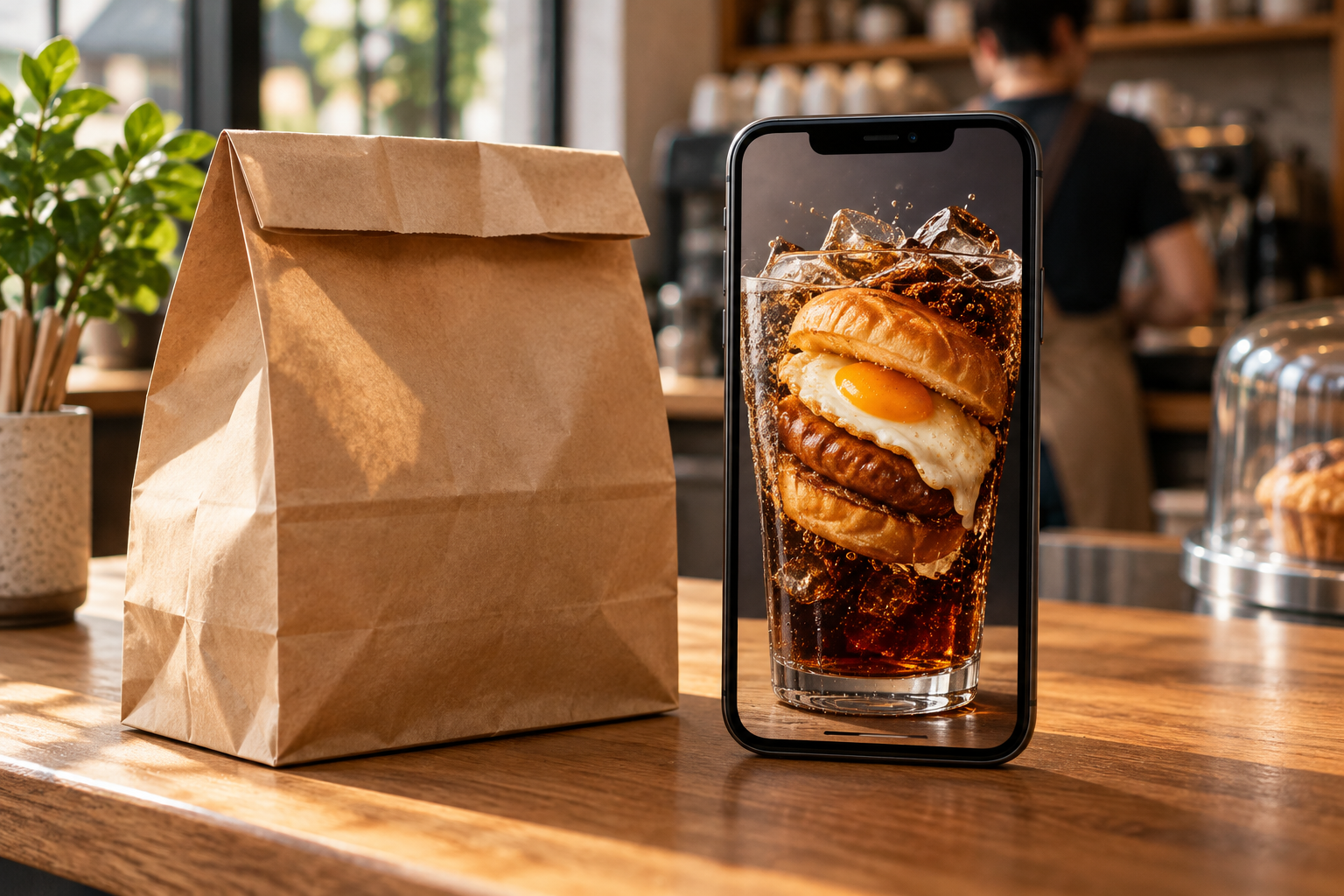
Picture a café owner in Northern Ireland. She makes soda bread breakfasts. Sausage, bacon, fried egg, bit of butter, proper job. She has never put a photo of it on her delivery app listing, because it's a Tuesday and she's flat out.
Then a customer messages her. The listing has a picture. It shows sausages, bacon and fried eggs floating in a pint of fizzy drink.
She didn't take that photo. She didn't ask for it. She didn't even know it existed.
That is not me being cute. The Independent reported on 19 October that Just Eat's AI image tool misread a café's soda bread dishes and illustrated them as meat floating in cola. The app had been generating pictures wherever a restaurant hadn't uploaded its own, and tagging them as AI-generated.
What else the machine got wrong
The soda bread one is the funniest, so it got the headlines. But the same report lists a few more.
Salt and pepper chips, a staple on Chinese takeaway menus, normally come with fried onions, chilli and peppers. The AI drew plain, blandly seasoned potato chips instead. A cheddar cheese add-on on one café's vegetarian menu turned into an orange, fondue-like sauce.
One customer on X put it better than I can. They said they'd be furious if their salt and pepper chips turned up looking like the AI version.
Look, that's the real point. The customer doesn't blame the app. They blame the shop that sent the wrong thing. The name on the bag is yours.
Nobody was being lazy
But I want to be fair here. This isn't a story about a daft tool and a careless company.
Just Eat's statement, quoted in the same article, says they want partners to show photos that accurately reflect their dishes, so customers can be confident in what they're ordering. They said they've been trialling AI-enhanced images and that, as with any new technology, it isn't always quite right the first time. They apologised, started removing the images, and paused the rollout.
That's a decent response, to be fair. It's also a response that came after customers had already seen the pictures and posted them online.
So the AI did what it was built to do. It saw "sausage soda bread" and had to come up with a picture, and it had never seen the café's food. A model guessing at a dish it has never seen is going to guess wrong on anything that isn't a full English or a generic curry. The Independent notes it got those right. It's the local, the regional and the slightly unusual that break it. Which is exactly what small independents sell.
The bit that should bother you
I don't run a café. But I do help businesses put AI to work, and this story has nothing to do with food.
And it's about a third party doing AI work in your name, on a page you don't control, without you signing it off.
Think about where else that's happening or about to happen:
- A marketplace writes your product descriptions from your supplier's data sheet.
- A directory generates your business summary from whatever it scraped.
- A booking platform "enhances" your photos.
- A review site writes an AI summary of what customers say about you.
But each one is a shop window you didn't dress. And each one is going to get something wrong sooner or later, because that's what these tools do when they have to fill a gap.
So here's the question I'd ask. If somebody put AI-written words or AI-made pictures about your business on a page today, how long would it take you to find out? For most owners I talk to, the honest answer is "when a customer tells me." That's the worst possible way to find out.
The fix is boring and takes twenty minutes
You can't stop a platform trialling a new feature. You can stop being the last to know.
- List every place your business appears that you don't own. Delivery apps, marketplaces, directories, Google, review sites, booking platforms. Write it on one page.
- Look at each one as a customer. Open it on your phone. Read what it says about you and look at what it shows. Don't trust the dashboard you log into, because that's often not what the public sees.
- Upload your own version of everything you can. The AI fills gaps. In this case it filled the gap where no photo existed. A real photo, taken on your phone in decent light, leaves no gap. That's the cheapest insurance in the story.
- Check the terms and settings for AI features. Some platforms let you opt out. Some don't tell you until you ask. Send the support email and keep the reply.
- Put a recurring check in your calendar. Monthly is fine. Ten minutes, phone in hand, scrolling your own listings like a stranger would.
If you've got a bit of automation in your business already, you can have it do the nagging. A simple monthly reminder with the list of links. Or a scheduled task that grabs a screenshot of each listing so you can compare against last month. Nothing fancy, sort of a smoke alarm for your shopfront. It just means the checking happens whether you remember or not.
If it's already on your listing
So you open the app and there it is. A dish you sell, with a picture that's miles off. Here's the order I'd go in.
First, screenshot it. Date and all. If a customer later says they were misled, you want proof of what the page showed and when.
Second, report it to the platform straight away, in writing, and say plainly that you didn't supply the image and want it removed. Just Eat said it's taking the inaccurate ones down, but that doesn't mean yours is on the list.
Third, tell the staff. If the picture promises something you don't serve, the person answering the phone should know before the customer asks. And it takes thirty seconds to say.
Last, put your own photo up, even a rough one. Don't leave the hole for the machine to fill again.
Where this lands
AI isn't the villain in this one. It did a daft thing, in public, on someone else's platform, because nobody told it what the dish looked like.
But that's what makes it useful. Next time it won't be soda bread. It'll be your pricing, your opening hours, your service descriptions. Something that costs you a customer instead of making them laugh.
You can't control every AI that touches your business name. You can control how quickly you notice. That's the whole game, and it costs a phone and ten minutes.
Want to see how this could work in your business? Book a call and let's talk about where you're at and what's possible.
Brewed by Steven, poured by Viktor
About Steven Tann: Steven helps business owners build systems that run themselves using AI. After 10+ years helping 7,000+ businesses and building his own autonomous operations, he's the bloke who actually does it, not just talks about it. Find out more at steventann.com.