Walmart Spent Billions on AI. It Still Shipped a Keypad With Two 7s On It
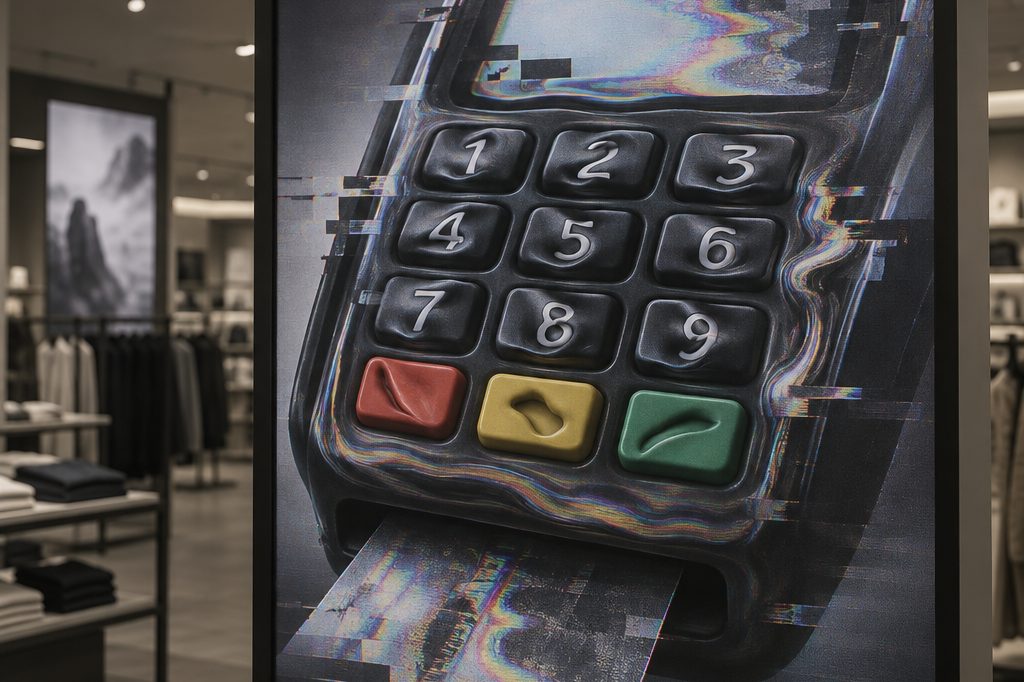
Walmart put up a sign in its stores this month announcing tap-to-pay is finally coming to its checkouts. Big moment for the world's biggest retailer. Fast, easy, modern, all that. Except somebody generated the artwork with AI, nobody looked at it properly before it went to print, and the payment keypad in the picture has two number 7s on it. No 4. Two 7s. Mangled symbols everywhere else too, the usual AI slop tell where the picture looks fine until you actually read it.
The internet did what the internet does. Screenshots everywhere, someone calling it "AI is so scary it's like the words you read in your dreams where it doesn't actually say anything," someone else pointing out that a billion-dollar corporation apparently couldn't stretch to a graphic designer. Yahoo Tech has the full rundown if you want the screenshots for yourself.
So here's the bit that should worry you more than it should amuse you. Walmart has an entire marketing department. Legal review. Brand guidelines thicker than a phone book. Multiple layers of sign-off before anything goes to a store. And a keypad with two 7s on it still made it all the way to a physical display in an actual shop. Not a draft. Not a Slack thread. A printed sign, in a store, that customers walked past and photographed on their phones.
If that can happen inside Walmart, what do you reckon is happening inside your business right now, where the AI image tool sits between "type a prompt" and "post it to Instagram" with nobody in between?
This Isn't Really About the Keypad
So the keypad is the funny bit. The actual lesson is duller and matters more: AI image generation is brilliant at things that look right and rubbish at things that have to be right. Faces, hands, text, numbers, logos, anything with a specific correct answer. It's pattern-matching what a keypad generally looks like, not counting to make sure there's a 4 on it. Same reason AI writes confident nonsense when it doesn't know a fact. It's not lying to you. It genuinely does not know the difference between a keypad and a picture that resembles a keypad.
Small businesses are leaning on this stuff hard now. A Fractl/TrustRadius study reported by CMO.Works found only 54% of marketers fact-check AI-generated content before it goes out, meaning 46% publish it straight, no second look. And that's not just copy. That's images, that's social posts, that's the sign in your shop window or the flyer in your letterbox.
But you are not Walmart. You do not have a marketing department, a legal team, and a brand police squad standing between your AI tool and the world. In most small businesses I work with, it's one person, generating an image on their phone in the car park before a meeting, uploading it straight to the Facebook page. There is no second pair of eyes. There is no sign-off. There's you, and whatever the AI decided a keypad looks like.
Where This Actually Bites You
Think about where you've used an AI-generated image in the last month. A social post. A flyer for a promotion. A "meet the team" graphic. A menu redesign. A product photo mockup because you couldn't get the real thing shot in time.
Now think about whether anyone actually read every word and counted every button before it went out. Not glanced at it. Read it.
I've seen this exact failure mode play out small. A tradie mate of mine generated a "we're open over the bank holiday" graphic for his window cleaning round, and the AI put a date on it that didn't exist that month. Nobody caught it because nobody was looking for a date, they were looking at whether the graphic looked nice. A cafe I know ran an AI-made specials board photo with a price that had an extra zero on it, sat in the front window for four hours before a customer pointed it out laughing. Small stuff. Embarrassing stuff. Nobody died, but it's not a good look, and it's completely avoidable.
The fix isn't "stop using AI images." That's the wrong lesson, and honestly, ignore anyone telling you that. The fix is knowing exactly which parts of an AI-generated image are load-bearing, meaning they have to be factually correct, and checking those specific parts every single time, rather than eyeballing the whole thing for vibes.
The Three-Second Check That Would Have Saved Walmart
Before anything with AI-generated text, numbers, or specific details goes out the door, run this:
Read every number, don't just look at it. If there's a keypad, a price, a date, a phone number, count it and read it digit by digit. Your eye will skim past "two 7s" because it's looking for "does this look like a keypad", not "is this a correct keypad."
Check anything with a fixed correct answer. Logos, addresses, opening hours, prices, dates. These are the things AI is most likely to get subtly wrong because it's generating "a thing that resembles X" rather than "X."
Get a second person to look, even for thirty seconds. Not for the vibe, specifically to hunt for errors. Different person, different eyes, catches different things. This is the bit that actually would have stopped the Walmart sign, someone whose job was to look for wrong, not just look at it.
Ask yourself if this is going somewhere permanent. A test image in a group chat is low stakes. A printed sign in a shop, a flyer that's gone to the printer, a social post that's about to run as a paid ad, that's a different level of "did anyone actually check this."
And none of this takes long. It takes about the same amount of time it took Walmart's customers to notice the extra 7 and start screenshotting it. The difference is whether that thirty seconds happens before it ships or after the internet's already laughing at you.
The Real Point
I use AI to generate images for this exact blog most days. It's fast, it's good enough for most things, and I'm not precious about it. But I look at every single one before it goes anywhere near steventann.com, specifically hunting for the bits that have to be right. Text. Numbers. Anything that would be embarrassing if it was wrong.
That's the whole difference between "AI helped me" and "AI embarrassed me in front of the entire internet." One extra look. Same tool, same speed, one habit that costs you nothing and saves you from being the next screenshot.
Want to see how this could work in your business? Book a call and let's talk about where you're at and what's possible.
Brewed by Steven, poured by Viktor
About Steven Tann: Steven helps business owners build systems that run themselves using AI. After 10+ years helping 7,000+ businesses and building his own autonomous operations, he's the bloke who actually does it, not just talks about it. Find out more at steventann.com.