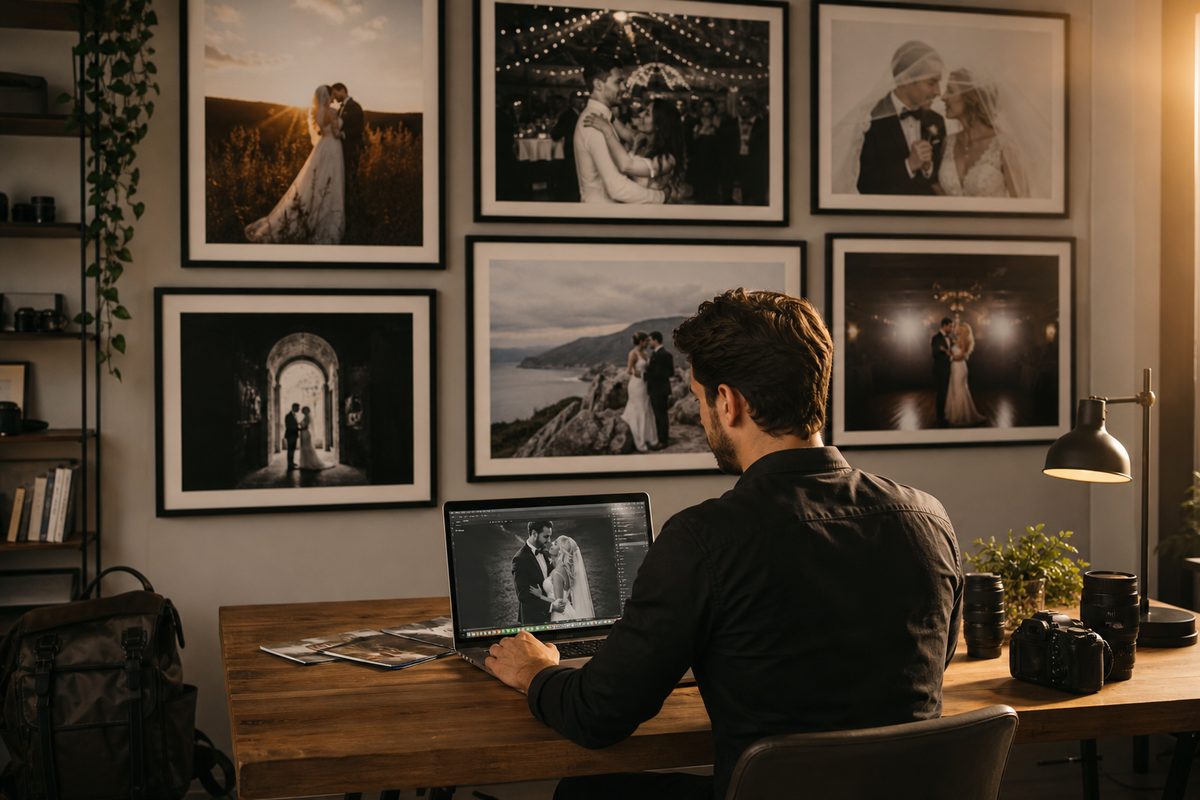
Claire is brilliant at what she does.
She has a gift for capturing the moment a groom's face falls apart when he sees his bride walk in. She can read light in a room the way other people read a room. Her portfolio is stunning. Her reviews are glowing. Her enquiry list in 2024 was longer than it had ever been.
And she was drowning.
Not in bookings. In email.
Every new enquiry kicked off a chain reaction: reply with the pricing guide, wait, chase, send the contract link, wait, chase, send the invoice, wait, chase, send the questionnaire PDF, wait, chase. Then the prep emails. The shot list form. The timeline document. The gallery delivery link. The "here are your edited photos" email. The "please leave us a review" email. The "your gallery expires in 30 days" email.
She counted it up one night. Seventeen separate manual touchpoints for a single couple, from first enquiry to final delivery. Seventeen. Times forty bookings a year.
That's 680 manual actions. Nearly 700 individual pieces of admin before she'd touched the photos.
Claire is not alone. The Professional Photographers of America published benchmark data in 2025 showing the average photography client journey involves between 15 and 22 distinct communication touchpoints. Most of them can be automated. Almost none of them are.
HoneyBook's 2025 Creative Business Report found that email communication alone consumes an average of 7.2 hours per week for photographers. That's not editing. That's not shooting. That's chasing, confirming, reminding, and sending things that could send themselves.
Claire had no team. She was a one-person studio. Every hour she spent on email was an hour she wasn't editing, wasn't learning, wasn't sleeping, wasn't living.
She told me she'd started dreading new enquiries. That sentence should stop you cold. A booked wedding photographer dreading a new booking because the administrative tail was so heavy she couldn't keep up.
The First Domino
Claire's situation isn't unique to photography. It's the pattern I see across every service business where the owner is talented at the core work and completely untrained in operations.
The work they love doing generates a thing they hate doing. And because they hate it, they do it slowly and inconsistently. Clients get a patchy experience. The owner burns out. Revenue stalls because there's no capacity left.
The solution is not to hire someone to do the admin. That's the expensive, complicated version of the answer.
The real answer is to build a system that does it automatically.
What the Photographer Actually Needed
When I sat down with Claire's workflow, the problems were obvious.
Every touchpoint existed in a different place. Contracts via one platform, questionnaires via Google Forms, invoices via PayPal, gallery delivery via a separate website, email via Gmail. No connection between any of them. Every single transition required her to remember to act.
That's not a workflow. That's a series of opportunities to forget something.
The fix wasn't about the tools. It was about the trigger chain. You need one event to automatically cause the next thing to happen.
Here's what we built.
Enquiry comes in through the contact form. Auto-responder fires within three minutes. Sends the pricing guide PDF, links to her portfolio gallery, and offers a link to book a discovery call. This alone eliminated two to three email exchanges per enquiry. The couple has the information before Claire has even seen the notification.
Couple books the discovery call via the calendar link. Confirmation email goes out automatically with everything they need. Day before reminder. Day of reminder. No manual chasing required.
Discovery call happens. Claire marks them as booked in her CRM. This single action triggers everything else. Contract generated from a template, pre-filled with their names, date, package and venue. Sent to them for e-signature. Invoice raised. Payment link sent. Both happen automatically.
Contract signed and deposit paid. The booking is confirmed. Prep email sequence starts. Two weeks before the wedding: shot list questionnaire goes out. One week before: timeline document. Three days before: day-of logistics email with meeting point, backup contact, what to expect.
After the wedding. Photos delivered via gallery link, sent automatically when Claire marks the gallery as ready. Seven days later, automatic nudge to favourite their selections. Thirty days later, reminder that the gallery will archive. Forty-two days after delivery, the review request goes out.
Seventeen manual touchpoints. Now two. Book the call. Mark the gallery as ready.
Everything else runs itself.
The Numbers
Setting this up took Claire around two days of work spread across a couple of weeks. She used HoneyBook as the central hub because it's built for creative businesses and handles contracts, invoices, questionnaires, and automation in one place.
The results were straightforward.
In my experience, when you take a business from zero automation to a properly triggered workflow, the immediate win is not more revenue. It's time returned. Claire got back around 10 to 12 hours per week that was previously consumed by admin.
PPA's 2025 benchmark data supports this. Photographers who automate their core workflows recapture 12 to 18 hours weekly on average. For a one-person studio charging, say, £200 per hour for additional session work, that's £2,400 to £3,600 per week in recovered capacity. Not all of that converts to money. Some of it just converts to Claire having a life again.
She took on six additional bookings in the first four months after setting this up. Not because she marketed harder. Because she had capacity. Because she wasn't spending Sunday evening manually chasing a contract signature that should have arrived on Thursday.
Táve's 2025 platform data showed that a complete booking pipeline automation reduces the average inquiry-to-contract time by 82%. Claire's experience matched. She used to have a three to five day gap between first contact and signed contract. After the system went in, it dropped to under 24 hours. Couples who are excited about booking don't stay excited for a week while they wait for a PDF attachment.
ShootProof's 2025 gallery analytics found that clients who receive automated delivery notifications view their galleries 3.2 times more often than those notified manually. That translates to a 45% increase in print and digital product purchases. Automated gallery workflows don't just save time. They make money. Because the touchpoints happen at the right moment, with the right prompt, every single time.
What This Looks Like in Practice
Claire's workflow now runs like this.
She shoots on Saturday. She comes home, downloads the files, eats dinner, sleeps. On Sunday she starts the cull. Nothing has to be chased. No frantic Sunday night emails to the couple saying "just to confirm, the deposit hit, we're good." The system confirmed that four weeks ago.
The couple gets a questionnaire automatically. They fill it in at midnight on a Tuesday if that's when they have five minutes. Claire gets the data in her CRM without having to do anything. The shot list appears in her job briefing the week before.
She marks the gallery as ready. One click. The automation sends the gallery link, the instructions, the download information, and schedules three follow-up touchpoints over the next 90 days.
The review request goes out on day 42 because that's when couples are back from their honeymoon and feeling warmly nostalgic. Not day 3 when they're still exhausted. Not day 180 when they've moved on. Day 42. Every time.
That timing is not something a human consistently does. A system does it without thinking.
The Business She Actually Wanted
Claire told me something that has stuck with me.
"I got into photography to be a photographer. Somewhere in the middle I became an email secretary who happened to take photos on weekends."
That's the real cost of running a business without systems. Not just the hours. The identity drift. The way a brilliant creative person ends up spending more of their life on admin than on the work that makes them brilliant.
The Autonomous Business is not about getting AI to do your creative work. It's about getting systems to do the stuff that isn't your work. The confirmation emails. The reminders. The follow-ups. The renewal nudges. The gap-filling that currently lives in your head and has to be manually executed every single time.
When you take that off someone's plate, they go back to being the person they were when they started.
Claire is shooting again on Saturdays and editing on Tuesdays and spending the rest of her week doing things that aren't her job. That's the win. Not the revenue numbers, though those improved too. The fact that she stopped dreading her own business.
If your business has a talent at its centre and a pile of manual tasks surrounding it, the talent is being eaten. The system fixes that. It's not complicated to set up. It doesn't require a developer or a tech background. It requires someone to map the journey, identify the triggers, and connect the dots.
Two days of setup. Permanently changed operating model.
That's the trade.
---
Want to see how this could work in your business? Book a call and let's talk about where you're at and what's possible.
---
About Steven Tann: Steven helps business owners build systems that run themselves using AI. After 10+ years helping 7,000+ businesses and building his own autonomous operations, he's the bloke who actually does it, not just talks about it. Find out more at steventann.com.